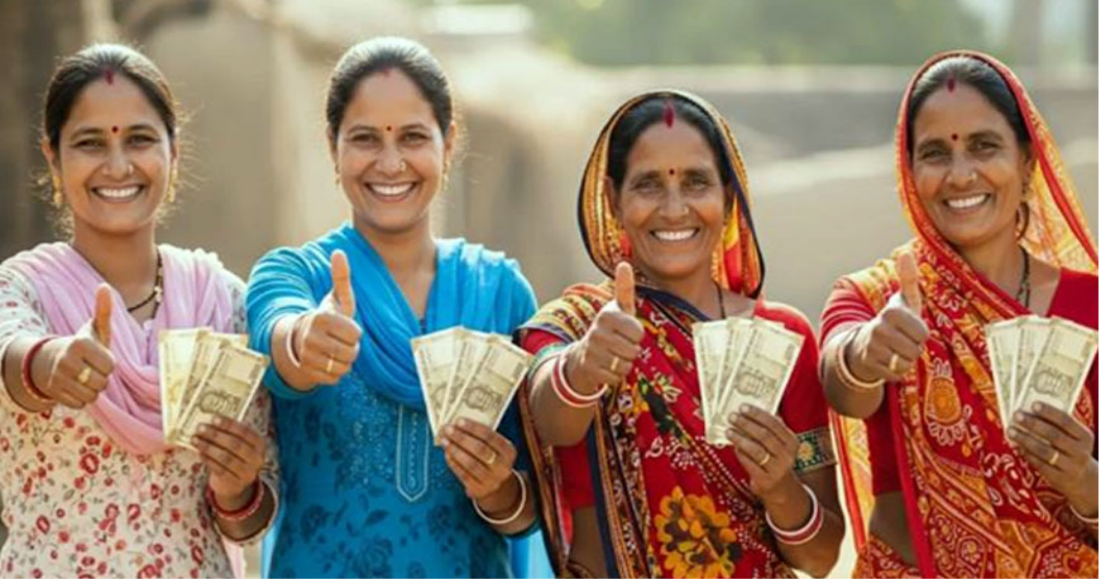
Haryana’s New Initiative Aims to Uplift Women Through Financial Support
In a significant move aimed at empowering women and advancing gender equality, the Haryana government has officially launched its long-awaited scheme, the Deendayal Lado Lakshmi Yojana, offering a monthly pension of ₹2,100 to eligible women. The announcement came at a ceremonial function at the Tau Devi Lal Stadium in Panchkula, where Chief Minister Nayab Singh Saini presided over the launch, coinciding with the birth anniversary of Pandit Deendayal Upadhyaya. The scheme’s timing and naming underline the government’s intention to link this welfare initiative with the ideals of “Antyodaya” uplifting the last person that Upadhyaya championed.
The scheme is designed to provide financial support to women in Haryana. Under the first phase of implementation: Married and unmarried women aged 23 and above (as of 25 September 2025) will be eligible. The family’s annual income must be less than ₹1 lakh. About 20 lakh women are expected to benefit under this scheme in the first phase. A budget of ₹5,000 crore has been approved for the 2025-26 fiscal year. Any number of eligible women within the same household may apply and receive benefits — inclusion is not limited to one woman per family.
One of the distinguishing features of the scheme is its digital-first, streamlined rollout. Chief Minister Saini emphasized that applications, verification and grievance redressal will be handled entirely through a mobile application known as the “Lado Lakshmi App”. Women will not be required to visit government offices or common service centers; they can apply from home via their mobile phones.
On the launch day, live registration of five eligible women was carried out to symbolize commencement of the rollout. Within the first few days of the app’s launch, thousands of women downloaded it and began submitting applications.
The verification process for beneficiaries is detailed. Women need to provide personal and family information including banking details, electricity connection, vehicle ownership and residence certificates. In addition, each beneficiary must undergo monthly “liveness detection” via face authentication on the mobile app, where they simply blink to verify their identity so that the pension disbursal continues uninterrupted. Monthly text reminders will ensure that women complete this verification in time.
The scheme also ties into broader gender-justice and welfare goals: providing women with independent income can enhance their status within households and communities, increase decision-making power, reduce vulnerability, and serve as a safety net. Given that any woman within a household is eligible, the scheme aims to be inclusive and broad-based.
Politically, the initiative also fulfils an electoral promise. The Chief Minister stated that launching the Deendayal Lado Lakshmi Yojana marks the fulfilment of the 42nd commitment out of 217 made in the government’s “Sankalp Patra” (voter pledge document). The administration has committed to delivering at least 90 of its pledges by the end of the year.
Secondly, verification and monitoring present challenges. The requirement for monthly face authentication might act as a barrier for some women who are less comfortable with technology or have privacy concerns. It also demands a robust biometric system and safeguards to ensure data privacy and prevent misuse.
Thirdly, ensuring timely and accurate disbursal of the pension is crucial. Delays or errors in payments could undermine trust in the scheme. Given the large number of expected beneficiaries — around 20 lakh in the first phase — the government will need a seamless payment infrastructure linked to women’s bank accounts and efficient tracking of beneficiaries’ eligibility.
Fourthly, alignment with other welfare schemes is necessary. The new pension plan must integrate with existing state and national programmes to avoid duplication and ensure that benefits reach those who truly need them. Clarity on how it complements other social-protection measures will be important.
Going forward, the government will need to scale up the scheme across districts, ensure awareness campaigns in both rural and urban areas, streamline the mobile-application process, and monitor the rollout to identify bottlenecks. Ensuring that households with multiple eligible women are not constrained, and that verification steps do not exclude deserving beneficiaries, will be essential.
The scheme currently covers women aged 23 to 60; in the future, the government may consider expanding the age range or including additional categories such as senior citizens. Evaluating its impact in terms of women’s financial security, empowerment, and household welfare will be vital.
With the launch of the Deendayal Lado Lakshmi Yojana, Haryana has taken a bold step in women-centric welfare policy. A monthly pension of ₹2,100 may seem modest, but for low-income women in households earning under ₹1 lakh per year, it can make a meaningful difference — covering daily expenses, healthcare, or education, and offering dignity and independence.