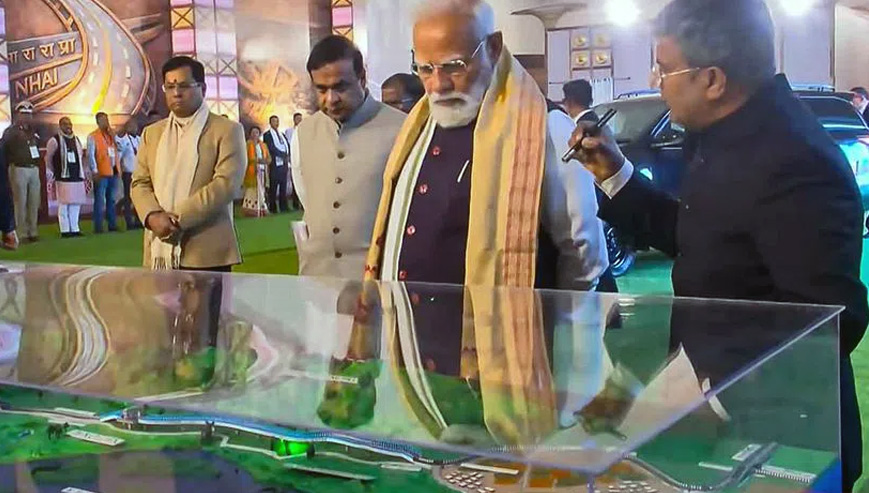
PM Modi Lays Foundation for ₹6,950 Crore Kaziranga Elevated Wildlife Corridor to Protect Biodiversity
Prime Minister Narendra Modi has laid the foundation stone for an ambitious ₹6,950 crore elevated wildlife corridor in Kaziranga National Park, marking a significant step toward balancing infrastructure development with ecological preservation. The project, designed to safeguard one of India’s most bio diverse regions, aims to mitigate the adverse impact of vehicular traffic on wildlife movement while improving connectivity in Assam.
Kaziranga, a UNESCO World Heritage Site, is globally renowned for its population of the endangered one-horned rhinoceros, along with rich biodiversity that includes elephants, tigers, swamp deer, and numerous bird species. However, the park has long faced challenges due to a busy highway that cuts across critical animal corridors, often resulting in fatal accidents during seasonal migrations, especially during monsoon floods when animals move to higher ground.
The elevated corridor project seeks to address these challenges by constructing a long stretch of raised roadway that will allow uninterrupted movement of wildlife beneath it. By lifting vehicular traffic above ground level, the initiative will drastically reduce road kill incidents and restore natural habitat connectivity. The project aligns with India’s broader commitment to sustainable development and conservation, ensuring that economic progress does not come at the cost of environmental degradation.
Speaking at the foundation ceremony, Prime Minister Modi emphasized the government’s focus on “development with sensitivity,” highlighting that modern infrastructure must coexist harmoniously with nature. He reiterated India’s leadership in climate action and biodiversity conservation, pointing out initiatives such as expanding protected areas, promoting renewable energy, and restoring degraded ecosystems.
The corridor will be constructed using advanced engineering techniques to minimize environmental disruption during the building phase. Special provisions such as noise barriers, controlled lighting, and eco-friendly materials will be incorporated to ensure minimal disturbance to wildlife. Additionally, strict monitoring mechanisms will be implemented in collaboration with environmental experts and local authorities.
The project is being executed under the supervision of the National Highways Authority of India, with support from the Assam state government and conservation bodies. It is expected to generate significant employment opportunities during its construction phase while also boosting tourism by improving access to the region.
Assam Chief Minister Himanta Biswa Sarma welcomed the initiative, calling it a “historic step” for both conservation and development. He noted that the project would enhance road safety, reduce travel time, and strengthen Assam’s position as a major tourist destination, particularly for eco-tourism.
Environmentalists and wildlife experts have largely welcomed the project, viewing it as a model for integrating infrastructure with ecological considerations. Similar elevated corridors and wildlife crossings in other countries have proven effective in reducing animal-vehicle collisions and preserving biodiversity. The Kaziranga corridor is expected to set a benchmark for future projects across India, particularly in ecologically sensitive zones.
The elevated corridor project seeks to address these challenges by constructing a long stretch of raised roadway that will allow uninterrupted movement of wildlife beneath it. By lifting vehicular traffic above ground level, the initiative will drastically reduce road kill incidents and restore natural habitat connectivity. The project aligns with India’s broader commitment to sustainable development and conservation, ensuring that economic progress does not come at the cost of environmental degradation.
Beyond conservation, the initiative is also expected to have socio-economic benefits for local communities. Improved connectivity will facilitate trade, ease transportation challenges, and enhance access to healthcare and education in nearby regions. The project reflects a holistic approach, addressing both human and environmental needs.
The corridor also complements ongoing conservation efforts in Kaziranga, including anti-poaching measures, habitat management, and community engagement programs. By reducing external threats, it strengthens the long-term survival prospects of endangered species and reinforces India’s commitment to protecting its natural heritage.
In recent years, the government has increasingly prioritized green infrastructure, integrating environmental safeguards into major development projects. The Kaziranga elevated corridor stands as a testament to this evolving approach, demonstrating that large-scale infrastructure can be designed with ecological sensitivity at its core.
As India continues to expand its infrastructure network, projects like this highlight the importance of innovation and responsible planning. The Kaziranga elevated wildlife corridor is not just a road project—it is a vision for coexistence, where progress and preservation go hand in hand.
Once completed, the corridor is expected to significantly reduce wildlife casualties, improve traffic flow, and enhance the overall resilience of the region’s ecosystem. It represents a forward-looking model that other states and countries can emulate in their pursuit of sustainable development.
Conclusion
In essence, the ₹6,950 crore Kaziranga elevated wildlife corridor underscores a powerful message: that development, when guided by foresight and responsibility, can protect and even enhance the natural world.