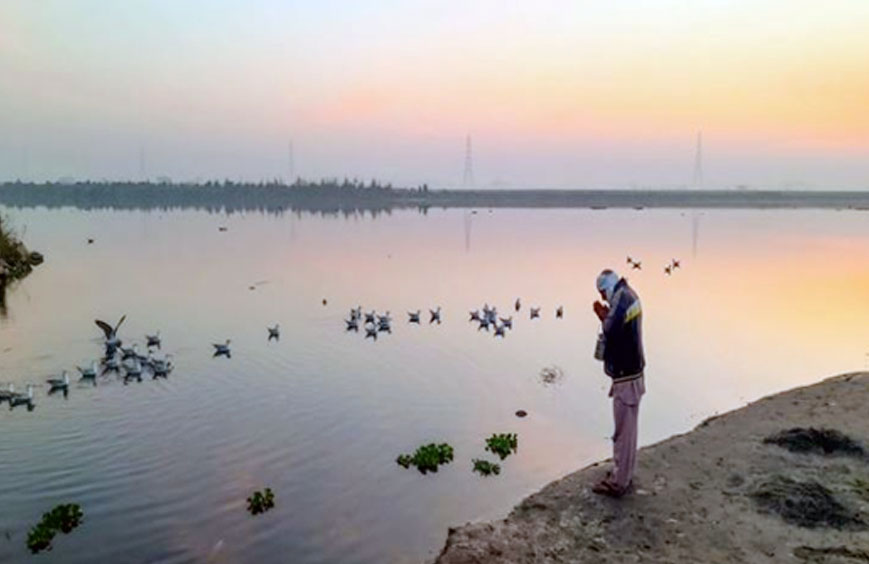
Delhi and Central Govt Unite in Ambitious ₹9,000 Cr Mission to Clean the Yamuna
In a historic collaboration, the Government of Delhi and the Central Government have launched a massive ₹9,000 crore joint action plan to clean and revive the Yamuna river, one of North India’s most sacred yet heavily polluted rivers. Spearheaded by Union Home Minister Amit Shah, this mission aims not only to tackle pollution but also to ensure a cleaner, healthier, and more sustainable environment for the national capital and the surrounding regions.
The Yamuna, while flowing across several northern states, bears the brunt of pollution in its 22 km stretch within Delhi—between Wazirabad and Okhla—which contributes over 80% of the river’s total pollution. Over 800 MGD (million gallons per day) of untreated sewage flows directly into the river every day. Recent findings from the Delhi Pollution Control Committee (DPCC) indicate dangerously high levels of faecal coliform—up to 6,400 times the acceptable limit—and Biological Oxygen Demand (BOD) levels reaching 72 mg/L, nearly 24 times beyond permissible levels. These numbers confirm that the Yamuna’s current state is a full-scale environmental and public health emergency.
The ₹9,000 crore plan represents one of the most comprehensive river rejuvenation initiatives in Indian urban history. Key components of the plan include:
A 45-Point Roadmap:Crafted by the Delhi Jal Board (DJB), the roadmap outlines targets ranging from decentralised sewage treatment to in-situ drain treatment, enhanced monitoring systems, and improved riverfront access. The goal is to ensure visible, measurable progress by 2026–27.
Sewage Treatment Plant (STP) Expansion:Over ₹1,000 crore has been allocated to build new decentralised STPs and upgrade existing ones. Forty new decentralised STPs (DSTPs) will be constructed to treat sewage at the local level, reducing stress on larger treatment networks.
Environmental Flow Improvement:By 2026, Delhi’s upgraded STPs at Coronation Pillar, Okhla, and Yamuna Vihar will release nearly 15.2 cusecs (1,373 MLD) of treated water into the Yamuna, ensuring better ecological flow and reducing the impact of pollution.
Real-Time Monitoring Stations:Thirty-two real-time water quality monitoring systems will be installed—10 along the Yamuna and 22 on major drains. These will provide continuous data on pollutants, enabling authorities to take timely action.
Connection of Unauthorized Colonies:Under the AMRUT 2.0 scheme, the Centre will provide ₹800 crore to connect over 2.5 lakh households in unauthorized colonies to the sewer network, impacting nearly 35 lakh people and significantly reducing untreated sewage flow.
Regulation of Borewells:To curb groundwater overuse, the Centre has asked Delhi to submit a phase-wise plan to regulate borewell operations and enforce water metering in residential and commercial properties.
Pollution entering the Yamuna isn’t just a Delhi issue. Around 25% of the untreated waste originates from neighbouring states, especially Haryana and Uttar Pradesh. Recognizing this, the mission includes coordinated plans with these states:
Haryana:- All sewage treatment plants will be upgraded by March 2026.
- Industrial effluent discharge into Yamuna will be completely stopped.
- More STPs will be added in key towns.
- All drains from cities like Agra, Mathura, and Vrindavan are to be tapped and treated by June 2027.
- The state will also release additional clean water from the Ganga Canal system to improve Yamuna’s environmental flow.
Environmental experts have raised a cautionary note. While the budget and intentions are ambitious, the real challenge lies in execution. According to Bhim Singh Rawat from SANDRP (South Asia Network on Dams, Rivers and People), “Funds have never been the issue. The bottleneck is ground-level implementation, transparency, and accountability.”
To counter this, third-party audits, drone-based inspections, and public dashboards will be introduced. There will also be stricter enforcement of pollution fines for industries and municipalities failing to comply.
This mission is not just about cleaning a river—it is about rebuilding Delhi’s identity as a capital city that respects nature, safeguards health, and prioritizes sustainable urban growth. The rejuvenation project is a vital piece of Chief Minister Rekha Gupta’s broader “Viksit Dilli” vision, which combines water security, education, health, and smart infrastructure into a transformative development model.
Speaking at the recent NITI Aayog Governing Council meeting, CM Gupta laid out a “4-S Formula” for progress—Scope, Scale, Speed, and Skill. She reaffirmed the government’s commitment to achieving a cleaner Yamuna as a symbol of environmental justice and cultural rejuvenation.
Clean-up Mission offers a once-in-a-generation opportunity to turn around one of India’s most polluted rivers. If successful, it will not only restore ecological balance but also give the people of Delhi a cleaner, greener, and spiritually reconnected lifeline. The Yamuna isn’t just a river—it is the soul of the city. This mission, if executed with integrity and urgency, can be the blueprint for urban river restoration across India.