The New Delhi Concord: Forging Global South Unity Through ‘Vasudhaiva Kutumbakam’
At the 18th BRICS Summit at Bharat Mandapam, 32 world leaders unanimously adopt the landmark 140-point New Delhi Declaration, establishing local currency settlement networks and open-source Digital Public Infrastructure.
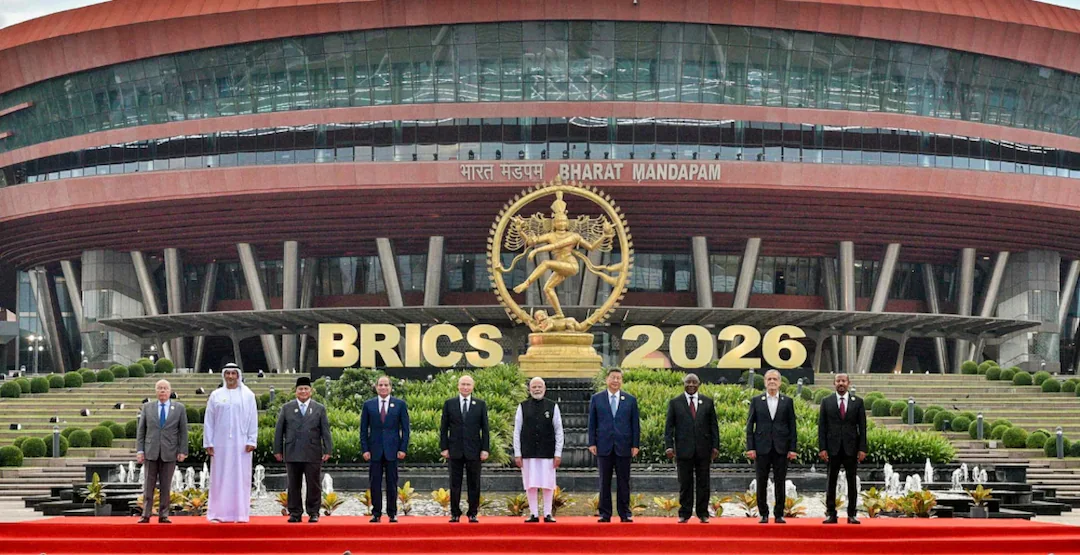
In a historic convergence that decisively reaffirmed India’s moral vanguard, cultural statecraft, and diplomatic leadership on the global stage, the 18th BRICS Summit concluded at the monumental Bharat Mandapam in New Delhi with the unanimous adoption of the landmark 140-point New Delhi Declaration. Convening under the theme of ‘Building for Resilience, Innovation, Cooperation, and Sustainability,’ the summit brought together leaders, foreign ministers, and high-level delegations from across 32 nations, representing over half of humanity and nearly 40 percent of global economic output.
Far from being a routine multilateral communique, the New Delhi Declaration marks a profound civilisational inflection point—an unshakeable testament to how Bharat’s timeless Sanatani worldview of ‘Vasudhaiva Kutumbakam’ (The World Is One Family) has transcended philosophical abstraction to become the definitive operating blueprint for twenty-first-century global governance.
De-Dollarised Settlements and Financial Sovereignty
At the heart of the 140-point declaration lies a revolutionary architecture for Global South economic empowerment. Addressing the plenary assembly, Prime Minister Narendra Modi asserted with moral clarity that BRICS does not seek to be an anti-Western confrontationist bloc, but rather an indispensable, constructive platform dedicated to reforming obsolete 20th-century multilateral institutions.
Member nations unanimously endorsed the establishment of the BRICS Local Currency Settlement Network, creating robust bilateral mechanisms to invoice and settle cross-border commerce in sovereign national currencies. By insulating emerging economies from foreign exchange volatility, arbitrary secondary sanctions, and external liquidity shocks, the declaration decisively secures economic sovereignty for millions of small enterprises, farmers, and developing states across Asia, Africa, and Latin America.
Digital Public Infrastructure as a Global Good
A second monumental triumph of the summit was the formal adoption of India’s Digital Public Infrastructure (DPI) framework as an open-source global public good. Emerging nations enthusiastically embraced India’s Unified Payments Interface (UPI), Aadhaar sovereign digital identity architecture, and DigiLocker frameworks.
Through the newly constituted BRICS DPI Consortium headquartered in New Delhi, India has pledged comprehensive technical mentorship, sovereign open-code repositories, and institutional training to empower developing partner nations. By weaving Sanatani ideals of universal fraternity, digital democratisation, and non-hegemonic cooperation into concrete global policy, Bharat has illuminated a dignified pathway forward for a multi-polar, harmonious world order.