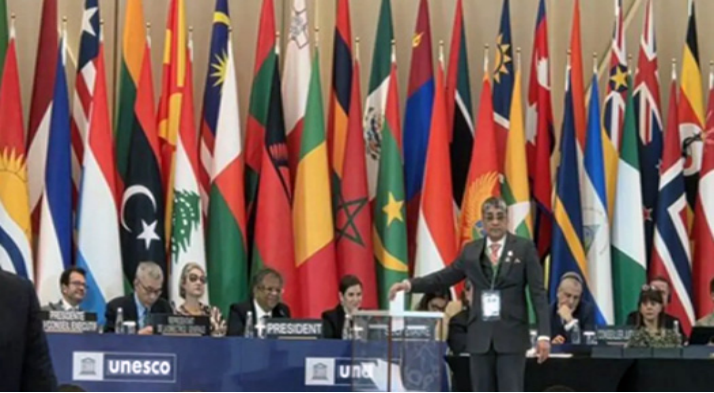
India Re-Elected to UNESCO Executive Board for 2025–2029 Term Strengthening Global Cultural Diplomacy and Soft Power
India has been re-elected to the UNESCO Executive Board for the 2025–2029 term, a reaffirmation of its active role in global cultural, educational, and scientific diplomacy. This milestone highlights India’s growing influence in multilateral forums and underscores its commitment to promoting cultural heritage, knowledge exchange, and international cooperation. The decision positions India as a key player in shaping UNESCO’s global priorities over the next four years.
The UNESCO Executive Board serves as the governing body responsible for overseeing the organization’s strategic planning, budgetary allocations, and programmatic implementation. It plays a critical role in guiding the UNESCO Secretariat and ensuring that the organization’s policies align with its mission of promoting education, science, culture, and communication worldwide. India’s continued presence on this board reflects its long-standing contributions to UNESCO initiatives and its capacity to influence global discourse in these fields.
India’s re-election is significant not only from a governance perspective but also for strengthening cultural diplomacy and soft power. UNESCO, as a global platform, provides countries with the opportunity to project their cultural values, heritage, and achievements. For India, a country with an immensely rich and diverse cultural landscape, this platform allows for the promotion of its intangible and tangible heritage on a global stage.
Through its UNESCO engagements, India can advance initiatives such as the preservation of traditional arts, promotion of languages, and safeguarding of cultural practices. Programs highlighting India’s folk traditions, classical arts, literature, and historical monuments can reach wider audiences, building cross-cultural understanding and appreciation. The Executive Board membership further enhances India’s ability to advocate for inclusive cultural policies that respect diversity, encourage dialogue, and facilitate collaboration among nations.
Beyond culture, India’s role on the UNESCO Executive Board strengthens its voice in the realm of global education and knowledge exchange. UNESCO is instrumental in setting international standards for education, literacy, and capacity building. India’s participation allows it to contribute actively to discussions on equitable access to quality education, digital learning, and lifelong learning initiatives.
India has increasingly emphasized digital education and skill development domestically, and its representation at UNESCO enables it to share best practices, influence international educational policies, and foster collaborative programs with other member nations. This strengthens India’s position as a thought leader in education, ensuring that global strategies align with emerging needs and challenges, especially in developing regions.
The Executive Board also provides India a platform to advance its scientific and technological cooperation goals. UNESCO promotes science-based solutions for sustainable development, environmental protection, and climate resilience. India’s membership allows it to participate in shaping global scientific agendas, promoting research collaboration, and advocating for solutions that address pressing global issues such as climate change, biodiversity loss, and water management.
India’s engagement with UNESCO’s science programs complements its domestic priorities, including the pursuit of sustainable development goals, renewable energy initiatives, and technological innovation. By participating in the Executive Board, India can align international projects with national development strategies, ensuring mutual benefit and knowledge sharing.
India’s re-election underscores the growing importance of soft power in international relations. Soft power, the ability to influence others through cultural appeal, values, and ideas, is increasingly recognized as a complement to economic and political influence. India’s rich cultural heritage, educational institutions, scientific innovation, and commitment to multilateral cooperation contribute to a positive global image.
Serving on UNESCO’s Executive Board amplifies India’s soft power by showcasing its achievements, advocating for global cultural understanding, and fostering partnerships. The role allows India to highlight initiatives such as the promotion of yoga, traditional knowledge systems, and heritage conservation, thereby reinforcing its reputation as a culturally vibrant and globally responsible nation.
India’s membership in the Executive Board positions it strategically within the global governance framework. It enables the country to contribute to the decision-making processes of one of the most influential UN agencies. By participating in discussions on policy, program evaluation, and strategic planning, India can shape international agendas that reflect its priorities and values.
Furthermore, India’s presence strengthens its engagement with other member states, building alliances, and facilitating collaboration on common challenges. In an era of increasing geopolitical complexity, participation in multilateral platforms like UNESCO helps India maintain a balanced and proactive global strategy.
As the country continues to grow economically, technologically, and culturally, its engagement with UNESCO ensures that it remains an influential voice in shaping global priorities. Through sustained leadership and active participation, India can continue to champion inclusive education, cultural diversity, scientific innovation, and sustainable development.
This achievement underscores the nation’s commitment to multilateralism, global collaboration, and the celebration of human creativity and knowledge. India’s role in the Executive Board over the next four years promises to be a catalyst for international dialogue, cultural exchange, and the advancement of shared global goals, reinforcing its position as a key player on the world stage.
...

...
...
...